
Download environmental variables in R
The envar R package streamlines the retrieval and processing of environmental variables for ecological modelling. Preparing variables for macroecology and biogeography is time-consuming and requires the standardization of different sources to the same study area and/or the extraction of value across study points and/or the conversion to a common coordinate reference system. envar is an R package that allows the download of a wide range of environmental variables from different pre-existing sources, to make the whole process of retrieving variables easier and faster, and well integrated within the R environment.
Purpose and use
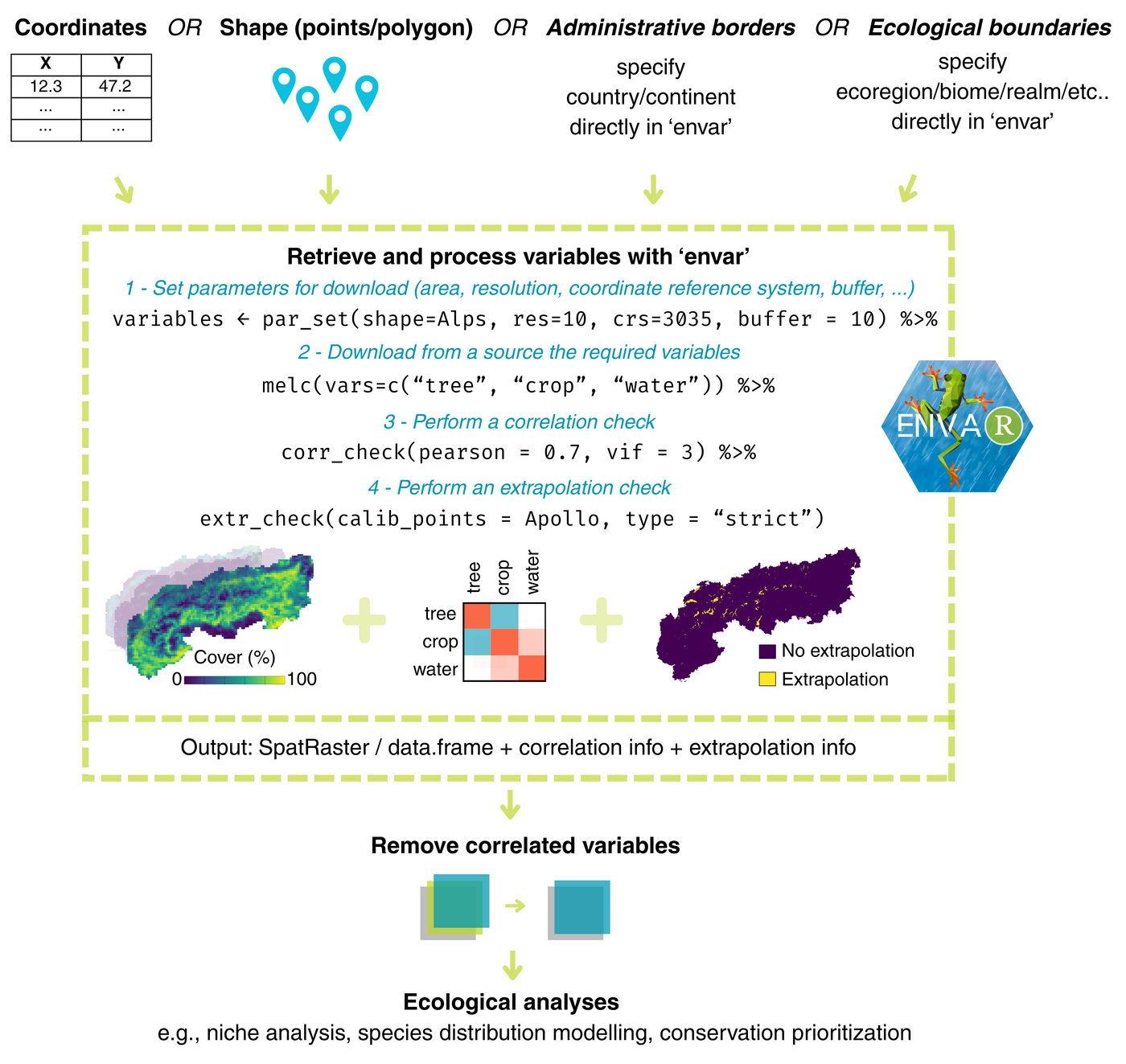
This graphic illustration depicts an ecological modelling framework and the use of the envar package to retrieve variables while checking for correlation and extrapolation. See below how to install the package and for more detailed explanation check Get started.
Installation
Official version
The latest official version of the envar R package can be installed from the Comprehensive R Archive Network (CRAN) using the following R code.
install.packages("envar", dependencies = TRUE)Developmental version
The latest development version can be installed directly from the GitHub repository to allow access to an always up-to-date package version incorporating all the most recent fixes.
- To install the latest development version from GitHub, use the following R code.
# install using the "remotes" package
if (!require(remotes)) install.packages("remotes")

remotes::install_github("animalbiodiversitylab/envar",
                        dependencies = TRUE,
                        build_vignettes = FALSE)

# or alternatively using the "devtools" package
if (!require(devtools)) install.packages("devtools")

devtools::install_github("animalbiodiversitylab/envar",
                         dependencies = TRUE,
                         build_vignettes = FALSE)
Once installed, load the package to run the examples and vignettes:
Functions
An overview of all functions and data is given here.
Did you find a bug?
We are glad that you found a 🐛 and you can report it on the GitHub Issues tab. Otherwise, you can send us an e-mail and we’ll do our best to rapidly fix the issue.
Dependencies
envar depends on terra, dplyr, httr, sf, rnaturalearth, usdm, corrplot, cli, fs, digest, rangeBuilder, and utils. The rnaturalearthdata package is also used (when selecting a study area by country or continent) and is installed automatically with rnaturalearth.
Citation
Please cite the envar R package when using it in publications, and the citation(s) associated with each source retrieved. The citations specific to each source are printed in the console during the download process. To cite the package, please use:
Simoncini, A., Bertoncini, M., Cerofolini, A., Dalpasso, A., Ficetola, G.F., Falaschi, M., & Lo Parrino, E. (2026). ‘envar’: an R package to retrieve and process environmental variables for macroecology and biogeography. Ecological Informatics, 99, 104033. https://doi.org/10.1016/j.ecoinf.2026.104033
Suggest additional sources
Users can request the addition of other sources, provided they contain variables at ~1-km resolution at the equator and with a global coverage, by e-mail to the maintainer at simonciniandre@gmail.com
Usage
Here we provide a short example showing how the envar R package can be used to retrieve and process environmental variables for a specific use case. To begin with, we will load the required packages.
# load packages
require(envar)
require(terra)
require(sf)

# download variables (e.g., the percentage cover of trees, ice and the slope) over a
# study area (in this case, the "Alps" shapefile already included in
# the package)
processed_vars = par_set(shape = Alps, res = 1, crs = 3035) %>%
  melc(vars = c("trees", "ice")) %>%
  topography(vars = c("slope"))
We will get a set of variables already cropped to the desired area of study, and presented as a SpatRaster file with multiple layers corresponding to the different variables:
# visualize the result
print(processed_vars)
#> class       : SpatRaster
#> dimensions  : 689, 1073, 3  (nrow, ncol, nlyr)
#> resolution  : 994.8978, 994.8978  (x, y)
#> extent      : 3845222, 4912747, 2192710, 2878194  (xmin, xmax, ymin, ymax)
#> coord. ref. : ETRS89-extended / LAEA Europe (EPSG:3035)
#> source(s)   : memory
#> names       :    trees,      ice,    slope
#> min values  :  0.00000,  0.00000,  0.00000
#> max values  : 99.99088, 99.62656, 37.86851
For a more in-depth explanation and examples refer to the Get started page.